Rachel Stainton:
On a busy night in a restaurant, everything you can see is working hard. The kitchen is firing on all cylinders, servers are weaving through the room, and guests are settling into their seats and the moment. But behind every busy dining room, there's another side of the business, one that rarely gets the spotlight, but always demands attention, the numbers.
For a lot of operators across the industry, the numbers can feel a little removed from the day-to-day rhythm, something you deal with at the end of the month or when tax day rolls around, or when your bank account balance suddenly looks a little bit different than you expected. When the financial side of the business isn't set up properly, the consequences have a habit of showing up everywhere else in missed opportunities, hidden profit leaks, and decisions made on shaky information.
Raffi Yousefian:
And the wrong information is worse than no information at all.
Rachel Stainton:
Hospitality businesses are different, high volume, thin margins, multiple systems feeding into the same set of books, and plenty of room for small errors to snowball into bigger problems, which is why having someone who actually understands the nuances of the industry looking at your books can make a huge difference.
Raffi Yousefian:
There's no reason not to have a specialist. Somebody that knows the nuances of restaurants, the ins and outs, the third party delivery reconciliation, the sales tax reconciliation, the timeliness of the reports.
Rachel Stainton:
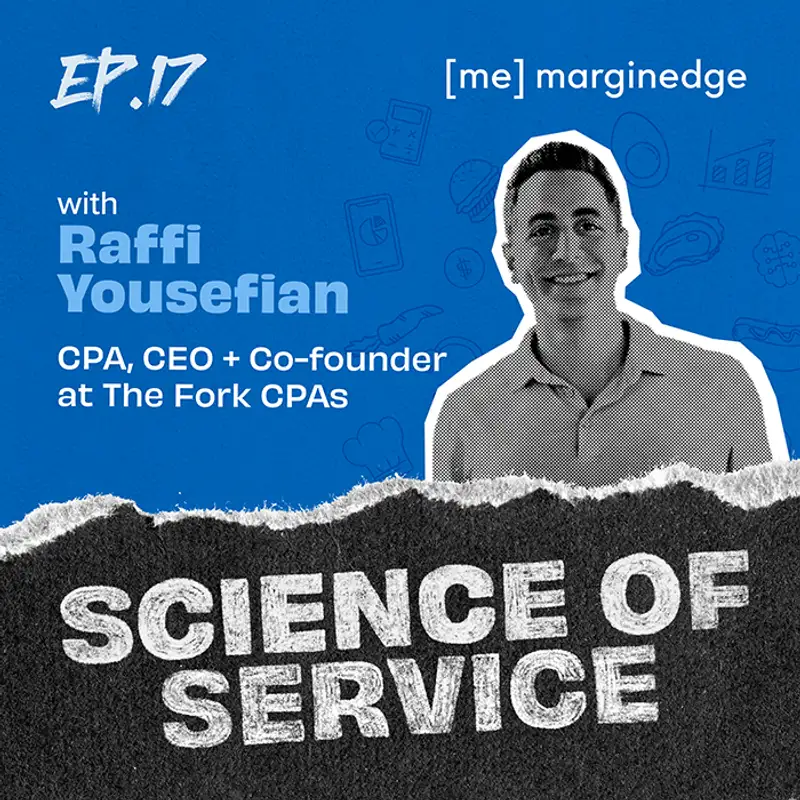
Our guest today is Raffi Yousefian, founder of The Fork CPAs, an accounting CPA and outsourced controllership firm dedicated entirely to restaurants and bars where he helps operators navigate the financial realities of running and growing hospitality brands. I'm Rachel Stainton, and welcome to Science of Service, the podcast where we uncover the strategies behind building successful hospitality businesses. Whether you're a seasoned operator or just starting out, you'll find insights and inspiration to help you thrive. And in this episode, we're diving back into the financial side of the operation from choosing the right accounting support to understanding the numbers that actually matter, and how better financial visibility can change the way you run your business.
Here on Science of Service, we definitely believe that what you know in business is the key to success, but honestly, who you know can also be a real game changer. In hospitality, especially for those family run spots where everyone's wearing 10 hats at once, knowing the right person often makes a big impact in the back office too. When you're grinding 24/7 and keeping a close eye on every penny, having a trusted face to handle the books is convenient, and often it's a lifeline. Whether it's your aunt with a finance background and some time on her hands after early retirement or your cousin with an accounting side hustle. For a lot of owner operators, that kind of help makes all the difference. And for Raffi, it turns out, the path into hospitality started very close to home.
Raffi Yousefian:
My first legitimate client in 2015-ish, 2016 was my brother-in-law who had a restaurant and catering company. And that sucked me in. I had other types of clients. And the restaurant industry and operations and personalities was definitely the most appealing for multiple reasons. But I think the most predominant reason why a lot of people open restaurants is the hospitality behind it, working with people, helping people. That's essentially what hospitality is. It's a really nice... It's very rewarding helping a main street business that really needs the help.
Rachel Stainton:
Let's talk a little bit about your firm, the Fork CPAs. What was the origin of that name?
Raffi Yousefian:
When we were developing the name with our marketing team, we wanted the name of the company to represent our values, our deliverables, our product, our client experience. And so we started off with the fork as a very easy to use tool that keeps things together.
Rachel Stainton:
The heart of hospitality is in the experience. But behind every great operation, the finances still need to stack up. For most owner operators, the passion is in the craft. Creating the experiences, looking after the guests, building something people want to come back to. The numbers side of things, that's often where the stress lives. But it doesn't have to be a headache. And regular listeners will know we've covered a lot of ground on this show, the systems, the data, the levers for growth, and how to navigate the tough patches when they come. Raffi's got some further advice on keeping your operation financially fit, and it starts with a question worth asking. Do you actually need a restaurant industry specific provider?
Raffi Yousefian:
I can't really think of a reason why you wouldn't want a specialist in any industry. Probably the only industry that you wouldn't want a specialist is maybe marketing because you don't want to use the same marketing firm that your competitors are using. But there's no reason not to have a specialist. Somebody that knows the nuances of restaurants, the ins and outs, the third party delivery reconciliation, the sales tax reconciliation, the timeliness of the reports. You need weekly reporting that reflects your cash flow, your prime costs.
It's just the nuances of the industry. And the competency aside, on top of that, beyond compliance, there's a lot of other value that comes with accounting. You have the financial reporting, the value added financial reporting, the weekly reports that you can actually use to make decisions that impact your bottom line. And you're most likely not going to be able to get any of that if the person is not an expert in restaurants and can give you what you need timely and accurately.
Rachel Stainton:
Yeah, very true. Is there anything outside of the volume or expediency needed that other firms that aren't industry specific miss about the restaurant industry?
Raffi Yousefian:
With restaurants, typically you want accrual basis accounting. And what that means is you want all of your daily sales entered into the accounting system. You want all your bills recorded. You want the inventory corrected every week. And without that, you're not going to get accurate reports. And that's a lot of work. So that's a really simple example of somebody that comes in that has never seen this before or has only done it a handful of times, might not know the fastest way to enter daily sales for seven days and 50 to 100 bills for the week and use systems. There are so many different systems, the POS, the inventory management software, the third party delivery system, obviously the restaurant management tools, the aggregators. The ones that bring in all the information like MarginEdge, xtraCHEF, R365. If you don't know how to use these tools, it's going to be very difficult to do full cycle bookkeeping and accounting for a restaurant, at least in an affordable way. I guess you could figure it out, but it might take you 80 hours a week.
Rachel Stainton:
Yeah. What about for restaurants or groups that try to do this in-house? What do you see typically go wrong when people, it's like, my mom's doing the books, or something like that. I got an uncle who has an accounting degree. What do you see typically go wrong?
Raffi Yousefian:
So doing it in-house is actually not necessarily a bad thing. For a lot of operators doing it in-house is actually a better fit. It just depends on what your priorities are, what your requirements are, what your goals are. Where it could go wrong is, instead of focusing on managing your restaurant, growing it, now you're having to handle or manage another person that's totally unrelated to what you know, which is restaurants. So whether that's one bookkeeper or a team of five accountants, you're hiring those people, you're interviewing them. You are training them. You are making sure they're setting up SOPs so that there's continuity and succession in case one of them leaves.
And after all that, what if they do leave? And that's typically the biggest problem is, okay, you hire all the people, you train them exactly how you want to train them, and then all of a sudden they leave. And if you don't find a replacement in time that gets up and running quickly and relearns everything, now all of a sudden your financials are months behind. It's difficult enough as an accounting firm maintaining that continuity in turnover. I just can't even imagine doing it if it's not your actual trade. That's one of the biggest downsides I think of doing accounting in-house.
So a lot of the times bringing it in-house, the benefit to it is you can customize things however you want. You're in full control. That person might even be on site, and they can be used for other admin tasks and really just be fully under your control at any point. So I believe that's why a lot of people would probably bring accounting in-house. But that obviously has downsides.
There are operators out there that are very sophisticated when it comes to financial management, accounting, financial planning. And for them, it might be a good fit to bring it in-house. Or to your point, have the aunt or uncle that happened to be a bookkeeper and they're just looking for some extra work, or the cousin or a husband, wife that wants to help. That can work well. But again, there's the competency and experience lacking where somebody that has the experience and track record can do things a lot quicker, more accurately, and provide you with more meaningful data.
Rachel Stainton:
Having a mantra is not really the MO for this show, but if we did, more meaningful data might be a strong contender. Raffi is firmly in the camp that says the right data at the right time is absolutely worth the investment. And he's not alone. We've heard plenty of guests across the industry make the same point. But if you're thinking about investing in financial tools or services, or you've already taken the plunge and you're wondering how to actually get the most value from those partners, where do you start?
Well, the first step might be a little surprising. Before you dive into reviews, dashboards, and data feeds, you need a bit of self-awareness. Don't worry. I'm not suggesting meditation retreats or an ayahuasca journey, although you do you. You just need a clear understanding of your business priorities, your goals, and crucially, your type as an operator. Like our amazing CFO in residence, Gina Cavendish, did in our recent shows on finances and growth plans, Raffi has done the groundwork to make life easier too. Once you understand what you're trying to achieve, the path forward becomes a lot clearer. Different goals lead to different choices and different tools to help get you there.
Raffi Yousefian:
I wrote an article a while ago called How to Choose a Restaurant Accountant, and I broke it down into three personas. And sorry, restaurateurs, I hate to put you in buckets, and I hope you don't get offended by this, but we more or less work with three different types of people. We have the bulldozer. So that's the first type of restaurant owner. We have the strategic operator. And then we have the visionary.
So the bulldozers are the restaurant owners who typically own one or two locations, maybe doing one to two million each in revenue. They're working night and day, running things super lean. It's probably a family business. These operations are super profitable, 30% profit, 40% profit. And they are there night and day, and they know how everything goes. So for the bulldozer, I always recommend just get the cheapest option. Just do enough from an accounting perspective so you can file your taxes.
And that might mean you hire a very simple monthly bookkeeping service and hire a separate CPA to do your taxes. Or not even a CPA. You can even probably get an enrolled agent, which costs less, because your taxes are probably not that complicated. And that's a good solution there. You don't need any fancy reporting. You definitely don't need weekly reporting. You don't need any bill pay.
Then we have the strategic operator. The strategic operator works both in the business and on the business. They value financial reports, timely data, weekly data. And they want to grow, they want to add locations, they want to make sure they run a lean operation, strong operation. Maybe raise money one day and grow it or maybe exit one day and spend time on what they do best.
For strategic operator, there are a lot of different options. They definitely don't want the least expensive cash basis accounting option, which I was recommending for the bulldozer. They're going to want industry standard reporting. So weekly prime cost reports, weekly snapshot reporting, flash reports, monthly P&L, balance sheet, cash flow. Understanding all your KPIs, your food and labor, on a weekly basis.
And the strategic operator can hire an outsourced accounting firm to do all that. They can hire the cousin that's a bookkeeper. But whoever they decide to hire for bookkeeping needs to be an industry expert that knows all the different systems that can get them the reports they need every week. It's very hard to find a freelance bookkeeper who can do this timely, accurately, and keep up with it. And even if you can, there's a single point of failure at the end of the day. If this person wants to take a vacation, you're not going to have your bills paid for two weeks or you're not going to get a report for two weeks. Or if they want to retire, then what? It's a little risky in my opinion.
Then you have the firm option, which is like a firm like ours. Even within the firm option, you have multiple choices. You can hire a traditional bookkeeping firm. You can hire a firm that also has a CPA practice or a tax practice. You can hire an outsource accounting/controllership firm, which is what we do. The main difference is bookkeeping is you're probably going to be assigned to a more low level bookkeeper throughout the year. And at the end of the year for taxes, you start talking to a tax preparer or CPA, or maybe every quarter. With the controllership, you get that high level person all the time, full-time access to that person. And that person will have an accountant, a bookkeeper that reports to them that's doing all the work.
I would probably recommend, call me biased, an outsource accounting firm for the strategic operator. It's just there's continuity, there's expertise, there's real-time reporting, there's strong accountability. And you pay a little bit more for that. It depends how you measure costs, but you're going to get a lot more value out of it. The other benefit of an outsource firm is just all the different perspectives. We have eight controllers at our firm. If one person's not familiar with the topic, they can quickly gather ideas from the others. So it's nice having access to an entire knowledge base of people, all different types of backgrounds and expertise.
And then finally, the visionary. The visionary is all about working on the business. They're raising money constantly, they're growing. They definitely either need to build an in-house team or hire, again, using an outsourced firm, outsourced accounting controllership firm. A bookkeeper won't do it for the visionary. There are some visionaries that are crazy about how they want things done, and they want to be in control from beginning to end. And for those types of operators, I'd probably recommend just build your own in-house team. It comes with a lot of disadvantages, but at least it'll be all under your control.
Rachel Stainton:
Whichever category you land in, bulldozer, strategic operator, or visionary, the common theme is control. Not the don't touch my station, or my mise en place kind of control, the kind that comes from knowing your numbers. And Raffi's three operator types are a pretty neat way of describing something real about how restaurant businesses evolve.
A bulldozer probably doesn't need fancy dashboards or weekly flash reports. What they need is something simple and reliable that gets the basics done. Strategic operators value better data to map out the next steps, understanding their prime costs, seeing trends week to week, and having someone who knows the industry helping interpret the numbers, that's where stronger financial systems start paying for themselves. And for the visionary, finance is closer to infrastructure. The reporting, forecasting, and controls that support growth and help ensure the business scales without losing track of the fundamentals. So if you've figured out which camp you fall into, you might be ready to start kicking the tires on a few new financial tools, maybe even take one for a spin. But before you get too far down the road, there's one small detail to consider, the price tag. And that conversation starts with the bulldozer.
Raffi Yousefian:
So this is typically like a cash basis, is what we call a cash basis accounting, really simple. You're basically doing all of the accounting based off of the bank transactions. Something like that would probably cost 4 or $500 plus a month. So for a million dollar business, they'd probably be paying $800, $900 a month for a service like that. And it also depends on your geography and all that, but that's kind of the lowest tier.
Then you move into the strategic operator where I recommended hiring an outsource accountant. They're probably going to cost around the same depending on your size and revenue. Let's talk about like a $2, $3 million restaurant, maybe a couple thousand dollars a month. That gives you weekly reporting, AP, bookkeeping, accounting. So it's more than double, but the value that you get out of it almost pays for the service itself. If you have a higher grossing restaurant, five million, six million, 10 million, then you're talking 4,000 a month, 5,000 a month, 6,000 a month. And then obviously the time it takes to account for a restaurant with eight million in revenue versus a restaurant with two million.
And the same goes for the visionary. That outsource accounting option is, it's going to depend on are you a franchise or are you an independent operation? How many different concepts do you have? Is it one set of books? Is it multiple sets of books? So it's a little hard to give a pricing rage on that. But if you were to compare in-house versus outsource, outsource would probably call 60 to 70% of what it would cost building an in-house team. You lose some flexibility, customization, and control, but you get continuity and a lot of time back.
Rachel Stainton:
And you talked a little bit about like you basically make back what you're spending. Can you talk just really quickly about the ROI of that? Yeah, you could be spending 2, 3K a month on financial services, but if they're finding you 1 to 2% in waste or something like that, can you speak a little bit on the ROI?
Raffi Yousefian:
Yeah, exactly. So RestaurantOwner.com has this very important stat, and we see it all the time in practice as well. Operators that view their prime costs or have access to their prime costs on a weekly basis save 2 to 4% on prime costs, which adds 2 to 4% to your bottom line basically. So just to keep it simple, a million dollar restaurant, 4%, $40,000, you've already paid for your accountant. That's how I like to look at it. And that doesn't even consider all the other stuff, like the theft, the fraud, the discrepancies, the overpaying of sales tax, all the other mistakes that can go wrong.
For a very long time, and I think even still, a lot of accountants were totally missing the third party delivery sales tax. Double paying it. DoorDash was paying it, Uber Eats was paying it, and then they were running the numbers through the POS, and the accountants were just saying, "Okay, well, that's the sales tax number," and they were paying it again. So double paying your sales tax, you pretty much ate up your entire profit. If sales tax is 10%, all your profit's gone.
Rachel Stainton:
For a lot of operators, financial services can feel like an overhead line item, something you have to pay for, but don't necessarily see huge returns on. But when the reporting is timely and accurate, when you're tracking prime costs weekly, catching mistakes early, spotting waste before it becomes habit, those numbers start to work for you.
Sure, experts come at a cost, but the savings they uncover can end up covering the bill and then some. And that's where the next decision starts to come into focus. Because once you've decided you need that level of expertise and visibility, the next question is how you actually bring it into the business. Do you build that capability in-house or tap into it through an external accounting firm? It all depends on your hospitality persona, of course.
Raffi Yousefian:
Yeah. So the outsource accounting firm has a much larger knowledge base. So depending on the size of the firm, whether it's 40 people, 20 people, 10 people, you all of a sudden have access to all these different experts, and not just the five people that are on your internal team or that single bookkeeper that you might have hired directly.
The same goes for tax services. If you're working with a tax shop that is just one partner, you're probably not going to get as much exposure and insight as you would if it's 10 partners. Because that partner, if they're ever stuck, they can go to one of their other partners and get their perspective. And if anybody ever leaves a firm, say it's your controller, say it's your account manager, that quickly reassigned to somebody else that's already kind of trained on your procedures.
Now that comes with loss in customization to a certain extent, and maybe some control. You might lose some control because you have to do things the firm's way versus your way. But most of the time, if you're working with a competent firm, they're doing things that have been proven over and over again because they've worked with hundreds, if not thousands, of restaurants, and have learned the hard way, for lack of better words.
Rachel Stainton:
I wonder, do you have any anecdotes or stories of an instance when something like that happened where you were experiencing something new and somebody else on the team knew how to deal with it?
Raffi Yousefian:
It probably happens on a daily basis here. So we have a group chat in our company, it's called the Controllers Chat. And almost daily, somebody's posting something in there, "Hey guys, I just noticed Toast has this new feature, the paid ins and deposit sales collected." I think everybody knows what I'm talking about. "How the hell does this work? Whatever we do, we just can't figure out why it's not reconciling." And everyone jumps in there, and puts, "Yeah, I don't know either. I just did this. I ran this report, and we figured out it was actually a prepayment on a third party delivery order." So, oh yeah, this happens so often because we don't know everything. It's invaluable just having a team of people that is so passionate and hardworking and really cares and is curious because you learn so much from each other. And yeah, so that's a huge benefit.
Rachel Stainton:
Yeah, you could say four tined forks are better than one tined forks.
Raffi Yousefian:
Yeah, exactly. Yeah, I like that.
Rachel Stainton:
So we've talked about different types of operators and the kinds of financial services that tend to work best for each of them. But whichever route you choose, from basic bookkeeping to outsourced experts or even a full in-house team, there's another piece of the puzzle, software integration. Hospitality finances live across multiple systems, POSs, scheduling, inventory, delivery platforms. And when those systems talk to each other, the numbers actually start to make sense. So what role does integration really play and what tends to go wrong when those systems aren't properly connected?
Raffi Yousefian:
For every industry, not just restaurants, it's more about systems management more than anything else, if you ask me. Is the POS pushing data to the restaurant management system? Is the restaurant management system pushing data to the accounting system? Where are the bills being uploaded from? Are all the bills being uploaded? Are they being reconciled with the vendor's records? I think 80% of what we do is systems management. We use MarginEdge, we use Restaurant365. And we're constantly ensuring all of those systems are talking to each other. And if they're not, how can you confirm the financials are accurate? I don't think you can. And so operators are making decisions based on wrong data. And the wrong information is worse than no information at all.
Rachel Stainton:
And when it comes to expansion, what are some of the mistakes you've seen operators make when they're trying to grow their business, and how can better financial understanding help mitigate these errors?
Raffi Yousefian:
Yeah. I think the biggest mistake we see is growing too quickly, growing before you have a proof of concept. And a proof of concept isn't just one location that makes money and has a line out the door. It's three, four, five locations that have 15 to 20% EBITDA, and have a line out the door, and are just a really hot concept.
So typically we'll see somebody has a really good first location, they get really excited and they sign leases for two or three more at the same time. And then the second one doesn't really stick. The third one, barely breaking even. And basically all the money that the first one made is now covering the losses of the second or third. For their first two, three locations, we want consistent performance, consistent track record before we go all in on like, oh, I'm going to scale this concept to like 10, 15 locations.
But you need to do it. Without opening that second or third location, how do you know whether you have a proof of concept? You got to take the risk. And I don't want to say you shouldn't be expanding, but maybe thoughtful expansion. We've had some clients come to us with four or five locations using what I described earlier as like the bulldozer accounting, cash basis. And high sales are probably the best and worst thing that can happen to you because they can mask all your mistakes while you make a lot of money. And so that's the thing, like cash basis accounting is all good. You see you're profitable, you see the bank account balance going up. But if you're running a 30% food cost instead of your expected 25%, how are you ever going to catch that if you're just looking at the bank account or your cash basis financials?
Rachel Stainton:
There's another area that has the potential to trip up operators, and that's the ever-changing world of tax rules and legislation. It's the kind of thing most operators don't spend much time thinking about right up until a policy shift or a new bill suddenly changes the math for your business. And over the past year, there have been a few of those changes, some subtle, some more significant. So before we move on, it's worth stepping back and looking at the bigger picture to understand how these changes could shape the financial landscape ahead.
Raffi Yousefian:
Yeah. So the biggest change from an operator's perspective or an owner's perspective was the 100% bonus depreciation, the no tax on tips, the qualified business income deduction is now permanent. They increased the state income tax deduction, the itemized deduction from 10,000 to 40,000. So these are the main things that changed as part of the One Big Beautiful Bill.
I think in practice, I think that's going to be obviously seen as like a perk to the industry. One thing to note though, that's temporary. It expires after three years. So they're trying to get restaurant owners and employees' votes, but there could also be challenges that come with this. A lot of restaurants are now following the service charge model. And that's going to create just a lot more challenges and obstacles to overcome between front of house, back of house, service charge restaurants versus tip restaurants. It's going to make it more difficult for those restaurants in places like DC that are phasing out the tip minimum wage, or have partially already phased it out. So that's the no tax on tips.
The bonus depreciation basically means you can write off 100% of any fixed assets that you purchase. So equipment, build out, furniture. And that began in 2018, and it was supposed to sunset, it was supposed to phase out starting 2023. So what they did was it reverted back to 100% starting January 20th of 2025. That's Trump's inauguration day. That was done on purpose. For those 19 days, you're getting a 40% write off instead of 100%. So those are the primary changes.
The other one was, which I mentioned, the state and local tax deduction limit was raised from 10,000 to 40,000. This actually has a pretty big impact. And I think most tax accountants will probably bring it up to their clients. I don't want to get too much into it, but it will have a pretty big impact on tax planning for 2026 and beyond. So just be aware of that.
Rachel Stainton:
Well, I'm no tax expert, thankfully, but that definitely feels like a job for someone who actually enjoys reading the fine print. But before we wrap up today's episode, let's put some of Raffi's advice to the test with a few real and slightly hypothetical scenarios. Say you're running a single location, things are getting traction, and up to this point, you've been handling the bookkeeping yourself, which obviously means you are apparently very talented. Kudos. But the business is growing. Your time is disappearing. And suddenly the numbers are competing with everything else on your plate. So what happens next? What are your options when an operator starts reaching that point?
Raffi Yousefian:
Your best option is probably going to be to hire a restaurant specialized accounting firm to take over your bookkeeping and accounting. And how much, what's your revenue?
Rachel Stainton:
Let's say a cool two million.
Raffi Yousefian:
Two million. Yeah. There are plenty of options out there, and I'll be happy to send you some recommendations.
Rachel Stainton:
Perfect.
Raffi Yousefian:
So you could separate your bookkeeping. You could hire a restaurant bookkeeping service and continue to keep your tax preparer separate. Or you could hire a firm that also has a tax department. It provides for a very nice and frictionless experience from the client perspective, but it's not going to really change your performance in any shape or form.
Rachel Stainton:
Okay. Let's say that I maybe own five to seven, five to 10 locations. Business is doing good, kind of like what you mentioned before, making a lot of money hand over fist. Bank account's going up at the end of the month. But I have no idea what's going on in my books. I really don't know what's happening with the financials. I know there are mistakes happening with payroll. How can I regain control of this situation?
Raffi Yousefian:
So I mentioned outsourced accounting firm that specializes in restaurants. There are firms that specialize in the one and two locations. And so it gets pretty specific. And then there are firms that specialize in more high growth or multi-unit locations. And so if you're at five to seven, and you're experiencing the same type of issues or hurdles, I would probably recommend hiring an outsource accounting firm that is more familiar with multi-units because it's a whole nother ballgame. Typically, you want to make sure there is somebody overseeing your account that is an experienced restaurant accountant. I want that advisor to be my point person, day-to-day point person that's constantly overseeing my financials, not just when I bring something up.
Rachel Stainton:
Yeah. Okay. Now for an operator of any size, do you have a piece of wisdom or advice that can be applicable to anybody trying to get a better sense or understanding of their finances? Like one thing they can do today?
Raffi Yousefian:
Make sure you have weekly access to prime cost reports that are generated by your accountant. Now, again, if you're under the one million mark, probably not as important. But making sure your bank accounts are being reconciled every week, your bills are being reconciled with vendor statements. And when I say bills, I mean the bills at your restaurant, the ones that show how much you've received in product and all the shorts and the credit memos, making sure you've been issued all your credit memos.
And yeah, at the minimum, you should be seeing a monthly or period end P&L. But also pay attention to the balance sheet. The balance sheet's very important. And that's typically where a lot of accountants will cut corners. And without a reconciled balance sheet, the P&L, I hate to say it doesn't mean much. And if you're getting prime costs weekly, make sure it's an accurate prime cost. All these great modern systems, Craftable, xtraCHEF, R365, MarginEdge, MarketMan, they're powerful tools, but they need a well-versed person overseeing them, making sure they're fed the correct data and set up correctly because if they don't match, something is off.
And employees know when there's not a culture of accountability, and they can take advantage of it. Not in a deceptive way or in a bad way. It's just when there's less accountability from a financial data perspective, the entire environment just becomes more lax around cost controls. Over usage, overportioning, waste. Hey, let me just take an extra can off the shelf. Nobody will note it. Little things like that can really add up when you're doing the type of volume that a restaurant typically does.
Rachel Stainton:
There's a lot to love about this industry, good food, good drinks, great people, and that addicting buzz of a busy service. The financial reporting side of the business for most operators tends to be a slightly less romantic part of the job. But understanding the numbers isn't just about compliance or keeping the IRS happy. It's about clarity, clarity that goes deeper than a profit and loss statement. It's going into the details that reveal what's really happening in your business, what's holding you back, where the leaks might be, and where the real opportunities to grow are hiding.
Thanks to Raffi for showing us that meaningful data, the right systems, and the right expertise can turn the financial side of the business from a blind spot into a genuine advantage. If you'd like the neatly reconciled version of today's key insights, you'll find it, as ever, waiting in the show notes. I'm Rachel Stainton, and if you enjoyed this episode of Science of Service, please rate, review, and subscribe. Thanks for listening, and we'll see you next time.