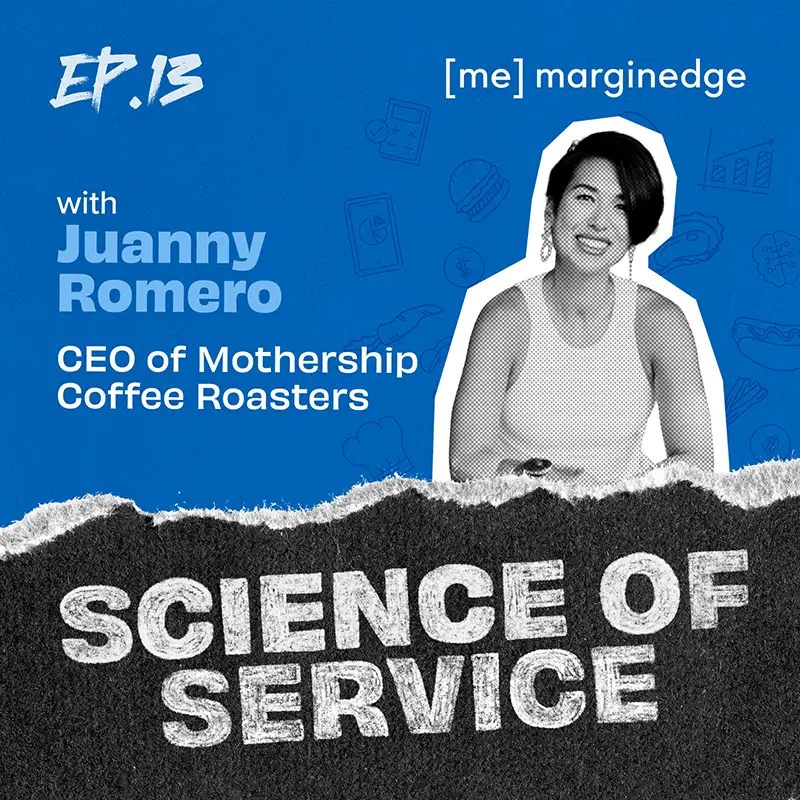
Rachel Stainton:
Purpose is a word we hear a lot in business. Put it on the wall, add it to the website, drop it into a team meeting, and hope it sticks. But what does it really look like when purpose isn't just a slogan? Last episode, we dug into purpose and hiring, how values can guide recruitment and retention. This week, we're taking it a step further because leading with purpose sounds great in theory, but in practice, it's messy. So how do you build a hospitality business that's ambitious and human, that wants to scale and make a difference? How do you do both without burning out your team or yourself?
Juanny Romero:
So I thought that I could step in and become the area manager for my chain of cafes. And I was literally the worst person for this position. I think five people quit in the span of six months. My turnover was like 174% of what our industry is. It was horrible. And I realized it was me. I was a problem. Just because I'm good at one thing doesn't mean I'm good at everything.
Rachel Stainton:
Our guest today is Juanny Romero, founder and CEO of Mothership Coffee Roasters, a coffee chain with a mission that stretches far beyond the counter. Expansion, franchising, revenue growth, it's all on the list, but so is strengthening her community and literally bringing enrichment.
Juanny Romero:
The biggest mental shift I had to make as a leader is to stop looking for shiny new objects. I get bored easily, and if I'm not doing something new, I can be quite destructive. And what I realized was to build a great company, I have to build great systems that people can follow, deferring my own gratification for results that can impact everyone.
Rachel Stainton:
This episode, we're talking about what it really takes to lead with purpose, how discipline beats distraction, why culture scales before the systems do, and how shifting from me first to we first can change everything for your team, your customers, and your bottom line. I'm Rachel Stainton and welcome to Science of Service, the podcast where we uncover the strategies behind building successful hospitality businesses. Whether you're a seasoned operator or just starting out, you'll find insights and inspiration to help you thrive. And if you're trying to grow without losing your soul, if you've got big ambitions but want to bring people with you, Juanny and this episode have you covered.
Some founders stumble into hospitality, others grow up in it, literally. For Juanny, the industry was her childhood, and that's where her story starts behind the scenes. Alongside her education at the school of hospitality hard knocks, Juanny gained insight into grit, empathy, and a deep respect for the people doing the work.
Juanny Romero:
I like to say that I grew up in the back of a kitchen. My parents are immigrants. I'm from Queens, New York. My father's Ecuadorian and my mother's Korean. So it was being the dishwasher, being the prep cook, being the sous chef, cleaning tables, you name it, bookkeeping. So I really grew up in the kitchen all my life.
Rachel Stainton:
Yeah. And what led you to coffee?
Juanny Romero:
Well, my parents always said, "Don't go into the restaurant industry." So I was like, great, I'll do coffee instead.
Rachel Stainton:
It's adjacent.
Juanny Romero:
Oh my goodness.
Rachel Stainton:
So can you tell me a little bit about Mothership? How many outlets do you guys have today and what is the mission behind the brand?
Juanny Romero:
So currently we have seven locations in Las Vegas. And the mission of the company is to personify my personal mission. And my personal mission is to transform 1,000 women's lives. My goal is to turn 1,000 women into millionaires. I started my cafe as a very young woman, and I grew up in the business. I just sort of went from the next thing to the other. I had a blast.
And eventually I started a family. And then somewhere along the line, after I had the white picket fence, the kids, and the house, I was like, I think there's something more, but I just don't know what it is. But there's something inside me that's not feeling satisfied. And it was beyond money, home, kids. It was something for myself that I hadn't quite figured out. And what I realized was that I needed to change myself. I wanted to give something to the world that was uniquely from my own experience and my own mind and my own heart. And with that transformation came the transformation of Mothership.
Rachel Stainton:
There's something about growing up on kitchen floors that stays with you. Real world education before anyone ever hands you a business plan. It's the kind of upbringing that teaches you the grind long before you start talking strategy. And I love how her parents told her not to go into restaurants. Funny how a don't can sometimes push us straight into the space where we actually change the game. For Juanny, coffee became her platform for impact, her drive to help change the lives of others.
Last episode, we spoke about a nonprofit training refugees and partnering with operators to solve labor shortages. This week, it's a coffee brand, but the thread is the same. Purpose as a business strategy, not a side project. And to build that strategy, Juanny had to change both the business and herself as a leader. It forced a rethink of everything, her mindset, her model, and what Mothership could become, from a single cafe into a purpose-driven network built around opportunity and growth.
Juanny Romero:
The biggest mental shift I had to make as a leader is to stop looking for shiny new objects. It's a really bad habit for a lot of entrepreneurs. I'm like any of them, I get bored easily. I don't like doing the same thing over and over again. And if I'm not doing something new, I can be quite destructive.
And what I realized was, to build a great company, I have to build great systems that people can follow. And that requires rigor, discipline, deferring my own gratification for results that can impact everyone. It really turned me from, I would think, more of a ego-driven person, which is me, me, me, to a team player. How can I help everyone at once? How can I create a win for everybody, not just myself? How can I create a win for my community?
Rachel Stainton:
It is tempting to chase what's exciting. Maybe too tempting sometimes. But it sure is a good point. Finding a competitive edge through leadership comes from disciplined processes and a culture that actually scales with the business. And that shift she made from me first to we first, that is huge in hospitality. Morale, retention, trust, all the things we struggle to protect in this industry. The moment a founder starts asking how do I create wins for everyone, everything changes.
The mission helped Juanny focus on purpose instead of the shiny object itch. And the purpose helped to make her a better leader, more patient, more disciplined, more intentional. And she's honest about it. There were learning moments along the way, times when she had to slow down, step back, and rethink how she showed up.
Juanny Romero:
So I thought as a CEO that I could step in and become the area manager. Because I was like, oh, it'll inform me and help me make better decisions and I could really see what's going on. And I was literally the worst person for this position. I think five people quit in the span of six months. My turnover was like 174% of what our industry is. It was horrible. And I realized it was me. I was a problem. Just because I'm good at one thing doesn't mean I'm good at everything.
And it informed me to respect everyone's position. It really made me respect our cashiers. It really made me respect our baristas who wake up 5:00 in the morning. It informed me to respect our roasters. And it also made me realize to respect myself, which is I am an amazing CEO, and a CEO only has six essential roles, and it is not what I was doing at all.
Rachel Stainton:
And letting go of control as you scale is very, very difficult, especially when you're so mission driven. How did you learn to trust others with the things you used to handle yourself?
Juanny Romero:
That was a really difficult pivot because trust is something that I had to learn how to trust myself first. I think we're not raised to be intuitive. I don't feel like I was raised to trust my own intuition. I don't think I was raised to feel confident in my own decision making. And that led to a lot of micromanaging. And what I noticed was there was a lot of turnover in my company because of that. And I just didn't know how to bridge that gap.
And one of the best things I ever did was join a peer group and start executive coaching. And through my executive coach, I learned about emotional intelligence. And likewise, it was my job to gain other people's trust over time. So that defined my behavior, being consistent, showing up, being respectful, being understanding, learning the art of listening. That's really important, right? It's something that in our culture now is not something that we prioritize.
Rachel Stainton:
Yeah. So as Mothership grew, how did you balance then staying hands-on with empowering your team and leading your team on the day-to-day? And then where do you draw that line in terms of your six roles as a CEO, not an area manager? How do you find that balance and where do you draw that line?
Juanny Romero:
The balance is it's reflected in my schedule. So currently we're focused on our vivid vision for 2029. We have three years where we're planning on achieving certain things in our company. So right now, my schedule has completely shifted. I only work in the company two days a week. So in those two days, that's when I take meetings, that's when I work with different teams, that's when I'll have my COO meeting with my executive. That's when I'll have meetings with my roasters, my catering department, to do a pulse check, my marketing department.
And within those two days, that's where I'm informed of decision making. And those are the days where I am making decisions if they're coming to me. But the other three days are not working in the company. The other three days are dedicated towards how do I get closer to my vision? How do I make a decision? How do I educate myself? So I'm ensuring at least three days a week. If I could, I'd love to do it five days a week because I only have about 40 to 50 hours max to dedicate to my vivid vision every week. But at least three days a week, I'm ensuring that I'm focusing just on that.
Rachel Stainton:
Balancing learning days with time spent deep in the operation is a habit a lot of strong leaders swear by. That kind of time blocking protects space for big picture thinking, while still keeping you grounded in what's actually happening on the floor. It's how you stay adaptable and future proof at the same time. And it links back to something she mentioned earlier, that spike in turnover when she took on the area manager role.
We've talked on this show before about what happens when leaders get stretched too thin. Those numbers really show why creating wins for everyone matters. Respecting each function, trusting people in their lanes, and giving teams ownership over their part of the guest experience, that's where culture starts to shift. Delegation becomes a growth lever, not a loss of control. And when you get that right, you buy yourself back some mental bandwidth, the space to actually think strategically instead of constantly firefighting, which brings us neatly to those six essential roles Juanny believes every CEO needs to master.
Juanny Romero:
So the six essential roles of the CEO has been really pivotal in informing me on what I need to be doing every day, and why I should be doing it. I don't want to take credit for it. It was my business coach who reminds us every month, "Hey, remember, this is why you're here. This is your function is as a CEO."
And the first one is to be the coach. It's super important to be able to coach my team around me. The second thing is being the advisor. How am I finding ways to treat my company like my own investment vehicle, which gives me a very removed perspective than every day going, this is my baby. I'm nothing without my company. That enmeshment isn't good for anybody.
At the end of the day, the company has its own ideas, it has its own mission, it has its own purpose. And a great company is a company where if I were to step away 100%, it would even do better without me. We're going from being an eight figure company to a nine figure company. And I say, "Hey, I might not be the right CEO as we grow, and I need you to let me know so I can step aside and hire the right person."
The third one is to be a mentor. That's really important because the more we mentor and the more we help facilitate the growth of the next generation of executives, entrepreneurs. Then the next one is to go out and be a salesperson. Any entrepreneur worth their salt should be a great salesperson, either by nature, or you figure it out because we're constantly selling. I'm selling to myself. I'm like, we're going to be a nine figure company.
Literally after I made that pronouncement and I had my executive strategy retreat, I created a 36 page vivid vision regarding it. Every night I was having anxiety attacks. And I was deeply uncomfortable. And all my brain kept saying is, you're a fraud, you're a fraud, you're a fraud. Even one night I woke up in the middle of the night and I said out loud, I stood up in bed, and I said, "Okay, I'm a fraud. All right. I admit it. I'm a fraud. But we had the retreat and everyone's now moving forward the vision. So we need to figure it out, guys."
And it's truly that, by being able to sell to myself, right? Saying, "You know what? Your right brain, this is true. You feel these things. But we're sort of still stuck with the challenge and the opportunity in front of us and we got to figure it out." And that's when my brain really was like, "Okay, fine. As long as you admit it. Fine. Now we'll help you figure out how to get there."
So first selling to myself, right? Selling to my leaders. I have to convince my leaders, you know what? We are worthy of being a nine figure company. They have to believe in what I'm doing to back me up. I can sell to investors. They have to believe what I'm doing. They have to truly believe. And so being able to sell is so important.
The fifth one is to remove the obstacles in the company's way. Be the visionary. Figure out where you want the company to go, and any obstacle that you think will come in your way, it is your job as a CEO to proactively remove them. For me, that looks very different. It might mean being able to remove myself from people who are working in the company that unfortunately our values didn't align anymore and having to make really difficult decisions to remove them.
It might mean ending a relationship with a vendor that I've had for 15 years, which is super important to me. Loyalty is very important. But knowing that it's not going to serve the growth of the company, that because their values have changed, or the culture of their company has changed, that it will only negatively impact everyone in my community. That's super important.
And then the last thing is, which I think is the most important, the thing that I'm most comfortable with is to being the strategist. Having a vision is great. I'm so excited that our company is going from eight figure to nine figure. Yay. How are we going to get there? It's my job to figure that portion out. Oh, we'll just add an extra zero with a Sharpie at the end of every P&L.
Rachel Stainton:
Problem solved.
Juanny Romero:
Done. Strategy resolved. That's my job is to be the strategist, and that is the most fun. I love the idea of going, you know what? I want to transform 1,000 women's lives. I want to make them millionaires. And then going, how? Oh, that's so exciting. Because let's say I fail. Let's say I only get to half. I get to transform 500 women's lives? That's amazing. I wouldn't have done that if I didn't push myself.
This might not seem possible now, but I trust in my intuition that, as a strategist, that I can get there. Now, not all CEOs are great strategists, and that's fine. Then you surround yourself with people who are. You surround yourself with advisors. I have different advisors for a lot of stuff. But strategy is my strong suit. I love having impossible goals, and then figuring out a possible way to achieve it.
Rachel Stainton:
There's a lot to unpack in those six roles Juanny mentioned. Coach, advisor, mentor, salesperson, obstacle remover, strategist. But let's pause on a couple of things she slipped in there. She's already been super honest about the fact that area manager wasn't her strong suit. And even bigger than that, she's openly questioning whether the future CEO of Mothership might one day be someone else. Taking a brand from tens of millions to hundreds of millions is a bold ambition, and recognizing that someone else might be better equipped to lead that next phase, that is real leadership.
The other thing she had to wrestle with was imposter syndrome. And yes, it's a total podcast buzzword, but it's a buzzword for a reason. It's hard to be ambitious without a bit of doubt tagging along for the ride. A healthy dose of self-questioning can be useful. We call it self-awareness after all. But saying it out loud, setting goals, and actually taking steps toward them, that's how you put imposter syndrome back in its box, and hopefully make it so there's one less voice rattling around when you finally get your head on the pillow. Which leads us to her last point, building a strong, committed team to help make those goals a reality.
Juanny Romero:
The one thing that I've had to work on that I think is the most valuable for any entrepreneur to work on is emotional intelligence. The things that got me to being an owner, my scrappy mindset, my can do attitude, my hold no prisoners was not going to help me build a team.
There's a really great parable that my friend told me over breakfast a couple years ago, and I want to mention that this is only something that's really happened in the past five years. I've had my company for 17 years. So for 12 years, I've been toiling with the wrong mindset. And he said, "If you want to go fast, go alone. If you want to go far, go together." And literally I'm at breakfast and my mind is blown.
And it's so true. It's so simple. Business is really foundational. We look at the unicorns and the shiny, bright companies that do these really cool and crazy stuff, but at the end of the day, everything is really foundational. And what changed my mindset from being an owner or CEO was, how do I build teams? In that moment, I just learned how to drop my identity.
Up to that point, I was Juanny who was a lone wolf. I was Juanny, who's willing to do anything to close the deal. But the moment after that, it was a completely new Juanny. And I realized, oh, my only job, if I focus on my emotional intelligence, if my EQ becomes higher, everything else will take care of itself. I watched in the first two years of having my business coach, maybe the first year and a half, my revenue in the company since I signed up with her went up 174%. And I truly believe it has to do with emotional intelligence. Because at the end of the day, yes, there are these major companies who are all about systems and this and AI, and everything that's technology based. But at the end of the day, I believe we're in the business of being human, and people sorely need human connection.
Rachel Stainton:
The best advice is so often the simplest. If you want to go far, go together. It goes to show that building your team isn't a one-day project. It's the work that makes everything else work better. And that 174% revenue lift after she invested in coaching, that number tells a powerful story, that so called soft skills like emotional intelligence, trust, and communication, they don't just feel good, they move the needle big time.
And if finding a mentor isn't really your thing, there are many things any operator can do instead of taking on an executive coach. Find a peer group, ask for honest feedback, carve out time for reflection instead of just reacting, and make sure you've got solid KPIs in place so you can actually measure what's working and what's not. Even small shifts in how you show up as a leader can have a huge ripple effect, which makes me a little curious. If this focus on people and EQ created that kind of impact, how does Juanny actually go about building team processes and measuring performance?
Juanny Romero:
So my first business I started, I walked in, it had been like some other chain cafe. They had literally left everything, shut the doors and walked out. It was the only landlord that would give me a location. In hindsight, I realized why. And I walked in, and I was digging through their bookshelves, things that they left behind. And I actually found their employee handbook manual. And I picked it up, and it was like this thick. And it was like, everything code of conduct. And I was like, "Who needs that?" And I threw it in the trash because I was so anti-establishment, counterculture, no one's going to tell me what to do. And I operated with such an immature mindset, thinking that's how everyone operated, that everyone didn't want to be controlled like me, that everyone else didn't want rules, that everyone else wanted to color outside the lines.
And when I started hiring my first employees, they taught me so much. They were like, "Juanny, this makes me scared." I was like, "What do you mean scared? It's exciting." They're like, "No, I want to know how to do it the right way." And I'm like, "Well, doing it the right way is the way you want to do it." And it was such a failure over and over and over again until I realized, oh, people think differently than me and that's where I started building systems.
I'm like, okay, how can I create SOPs that is easily understandable to the person, we go back to the cashier, to that position. And that's what we've created now, which I feel is like our most defining moment is how can we get this down to literally three steps? So everything in our company is three steps. For the cashier, what are the three steps you have to do? If you do these three steps, you are successful. Everything else you can make a mistake in. You don't know how to count the register, well, that's fine. If there's a mistake at the end of it, we'll have managers step in, you're not in trouble, we'll figure it out. But what are the three defining steps? And for our cashier is to make eye contact, smile, and say hello. And that is it.
So in the systems that we've built, we refined it so that we're really talking to the person whose intrinsic value in themselves matches the position and the work that they do, which then benefits the team, which then benefits the community, which then informs us as a company if we're on the right track, which is how do we as a company grow culture without losing authenticity?
Rachel Stainton:
Many founders struggle to scale their culture, and the more structure and systems that you build, the greater risk of losing what makes your brand special comes. What are some of the systems or habits that have been really big game changers for Mothership and helping it grow without losing its soul?
Juanny Romero:
It's really great you're asking that question because that's something that we're putting front of mind. As we grow, as we scale, as we onboard our first franchisees, we want to make sure that the most important thing is not the coffee itself in Mothership. It's turning customers into Mothershippers, into raving fans. And that completely has to do with culture.
So to your question, how do we scale culture, right? Because in a nutshell, that's scaling the unscalable. So how is that possible? Well, you can't scale it. All you can do is to have the right people who naturally have that inside of them. And it's just our job to cultivate, to guide, to help them express, to have agency, to make them feel good. Because when people feel good, they're just going to be naturally their best selves. So it's just our job to make sure that their working environment is good, they have a great time, they're laughing, they love their team. And when you do that and you have the right people in the right mix in teams, it becomes a blast.
Rachel Stainton:
Yeah. Are there any systems that you use in the stores or at the store level to ensure that people are having a good time, like perks or fun things, or any anecdotes you can share?
Juanny Romero:
I always thought if I put a ping pong table in every cafe, the culture would shift. And it really doesn't have effect on it. I think this generation, because we work with a lot of young people, this generation is pretty hip. They're pretty wise to a lot of things going on. They're a little bit more skeptical, world weary.
So if I were to talk about one thing, it goes back to building trust. It goes back to being authentic. They really, really value authenticity. Now, does that mean that they stay longer with us? No. We still have, just like everyone else in our industry, turnover of 100% in six months. But what we've noticed is when they leave, they leave happy. They say a lot of positive things. Sometimes they even come back. They try and do a corporate job, and they realize that, you know what, no other businesses or other teams really have that. And they'll come back for a while, be a barista for a little bit, lick their wounds, and then go back out, do another corporate job.
Rachel Stainton:
When ex-staff choose to return, even just for a little while, that's not an accident. That is a safe space. It says this place had my back. And in an industry where churn is the norm, that kind of boomerang loyalty is gold dust. If people feel respected, supported and trusted, they don't just work for you, they root for you, even after they've moved on.
It also takes us back to something Juanny said earlier about scaling the unscalable and finding the right people. This is the culture fit versus skill fit debate in real life. When values align, skills can be taught. And that's how you build a resilient, low turnover crew, one that actually wants to be there.
But you don't need me to tell you that growth has challenges. Sometimes it exposes the cracks in culture or communication. As Union Square's Abe Monzon shared in our last episode, culture is like a baby. It needs constant care and attention. And if it makes a mess, you clean it up straight away. So when those cracks start to show, how does Juanny nurture it?
Juanny Romero:
Instead of cracks, I like to say that they are opportunities. We're like, "Yay, here's an opportunity to become better." And the only way to become better is to know our gaps. And definitely it is challenging, you're right, but it's also a wonderful experience. And that's the one thing that I train my team is how can we embrace and smile and go, "Wow, aren't we lucky? We didn't know that we didn't put a camera over the safe. And aren't we so blessed that one of our employees taught us that if we don't put a camera above the safe, money goes missing."
Rachel Stainton:
Oh no.
Juanny Romero:
Thank you unknown employee for that opportunity.
Rachel Stainton:
Oh no.
Juanny Romero:
But it's true. And that's how I train my team. We don't go like, "Oh, I'm so angry at that employee. Oh, how dare they take our money. Oh." We go, "No, thank you. Thank you so much for the opportunity." And we remedy it instantly. I mean, that camera was in like two hours later, and it never happened again. But it's how we perceive these cracks, these challenges. And I can either train my team to perceive it as a threat, to perceive it as a gap where they didn't do enough, or I can have them perceive it as an opportunity to scale, to become better, to rise up to the occasion, to find ways to become different in order to adapt.
Rachel Stainton:
Wow. That is some next level resilience. Finding out you have missing money and saying thank you for the lesson. I mean, most of us would need a strong coffee or something even stronger, and maybe a little me time to calm down after that one. But what Juanny's showing us here is an incredible mindset shift, turning every crack into a learning moment. Celebrating the fix, not the failure.
That fail forward approach is exactly what turns a resilient team into a resilient operation. And it's something any operator can borrow. Take a quick gap to opportunity, debrief after an incident, cool the heat down from the moment, focus on what you learned, what you fixed, and how you get better next time. It protects your people, your culture, and your sanity. So taking that idea of moving forward, when things are hard, when there's friction, resistance, or a real mindset shift is needed, what advice does Juanny have for helping leaders get unstuck and to keep things moving?
Juanny Romero:
The advice I would give someone who is having struggle to leap from being owner to a CEO mindset is to be kind to themselves, number one. Understand that you're actually at the right space. That awareness is key because most people do not have that awareness that they're struggling. So number one, be gracious that you've had that awareness and you're there. You're there ready to make the leap.
Number two is truly make a list of who, for me, I would make a list of who I think I am versus who I think I want to be, who I want to become. So that vision is really important. There's always going to be a change. Juanny that was in sixth grade is not going to be the Juanny that's going to run a nine figure company, and that's okay. So I made a list. What does that Juanny look like who runs a nine figure company? Well, she's not upset or scared or stressed when she goes to a board meeting because she's made big deals already a number of times. She knows she has a great legal team for that and she trusts them. That's a very different Juanny than five years ago, who was like, oh my goodness, who had imposter syndrome. Do I belong here? And that's not the mindset of the CEO of a nine figure company because I already did it.
Stephen King has a famous quote. He says, "You have to kill your darlings." We have to be willing to let go of what we think our identity is and to take on new identity. And then the most important piece is I am the sum of the people around me. It's so true. The five people I keep near me informs who I am and who I'm going to become. And then after that, I would say is learn to trust a process, Learn to cultivate an intuition in this new landscape, and accept that I will make mistakes, and that is totally okay and it's very approved.
Rachel Stainton:
They're opportunities, right?
Juanny Romero:
Yes. All opportunities.
Rachel Stainton:
Before we wrap up, I would love to know what is the one coffee trend you secretly wish would disappear? Or if you could only drink one coffee for the rest of your life, what would it be, and what does that say about you?
Juanny Romero:
Okay. If I can only drink one coffee the rest of my life, it's going to sound silly, but I love the whole whipped cream, soft top, decadent-
Rachel Stainton:
A treat.
Juanny Romero:
... indulgent treat. I'm like, girl, I want to treat myself every single day. I know I'm obligated to say like, oh, it has to be an Ethiopian natural wash Guji, and it's been tested for blah, blah, blah, blah, blah. And I've never subscribed to that. You know what? Those people can keep their electrometers and testing gear, and only focus on working with this one region. And that's great because there's a whole bunch of people who love that. But for me, I want a community that's happy and having fun and engaging, and there's nothing like treating yourself that makes you feel good. You're telling me for under $10, I can have this drink and I could feel amazing. Yes, sign me up 100%.
Rachel Stainton:
It's funny how something as small as a daily coffee ritual can become a reminder of something bigger, that doing good often starts with feeling good. As Juanny put it, it's important to be kind to yourself. And maybe a little bit of self-indulgence is exactly what fuels generosity and shapes how we show up for others. You can't pour from an empty coffee cup after all. And whether you're running one outlet or dreaming of 100, the message is clear. When you lead with intention, invest in people, and allow your leadership to evolve, the business tends to follow.
If you want a recap of today's insights, you can find them percolating over in the show notes. See what I did there. My thanks to Juanny Romero for her honesty, energy, and for proving that doing good and doing well don't have to be separate goals. I'm Rachel Stainton, and if you enjoyed this episode of Science of Service, please rate, review, and subscribe. And if you know an operator who's building something with heart as well as hustle, send this episode their way. Thanks for listening, and I'll see you next time.