Rachel Stainton:
Right now, you can pick up or log on to just about any new source, and there's a good chance you'll find a sobering headline about the challenges of finding and keeping employees. Hospitality is, no surprises here, no exception. And in the reality of high churn, tight margins, and constant pressure to keep things moving, it starts to feel like the same problem is just on repeat, which begs the question, if everyone agrees this is an issue, why has it still been so difficult to solve?
Kerry Brodie:
I've never met a restaurant operator who said, "Actually, would love to just keep turning over staff." If we've all identified this is a problem that we want to solve together and we're all on the same page working against it, what are some of those fixes? And how do we think outside the box?
Rachel Stainton:
What if thinking outside the box doesn't mean doing something radical, but instead doing something intentional? What if solving staffing challenges isn't just about hiring faster, but about collaborating smarter? And what if the right partnership could support your team, strengthen your business, and still make sense financially?
Kerry Brodie:
I had this crazy idea that if we're able to build bridges around food and it felt like this was a moment where someone should do something, and my similarly naive and wonderful husband said to me, "You keep saying someone should do this. Why can't that someone be you?" And I think that that was definitely the most important question in my life.
Rachel Stainton:
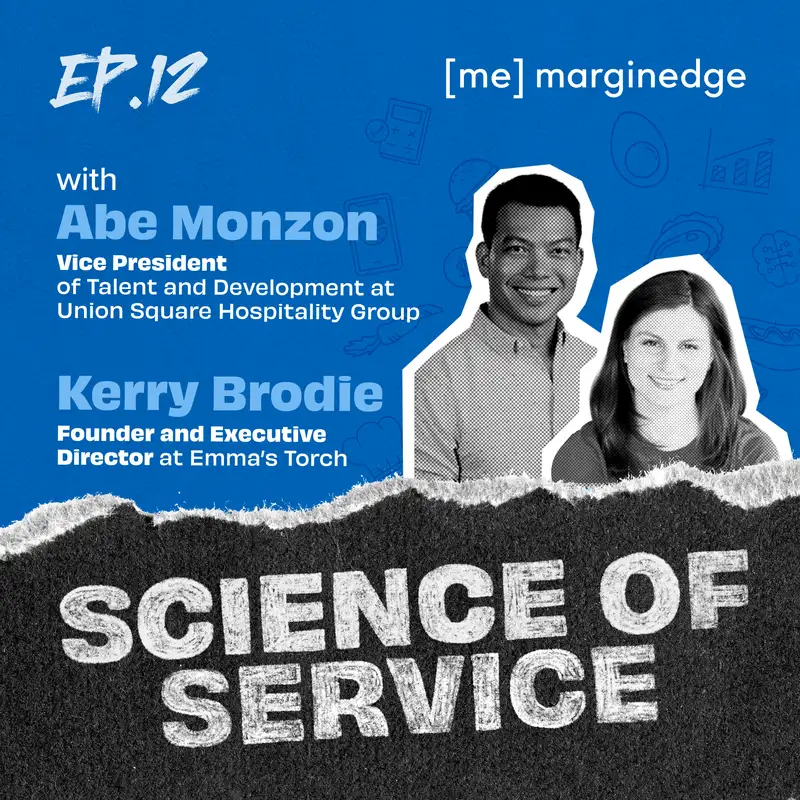
Kerry Brodie is the founder and executive director at Emma's Torch, and she's one of our guests today alongside Abe Monzon of Union Square Hospitality Group. Yes, that Union Square Hospitality Group. Together, they're exploring what happens when purpose and partnership meet the realities of hospitality and how doing good doesn't have to come at the expense of doing well.
I'm Rachel Stainton and welcome to Science of Service, the podcast where we uncover the strategies behind building successful hospitality businesses. Whether you're a seasoned operator or just starting out, you'll find insights and inspiration to help you thrive. And in this episode, we're digging into the work of Emma's Torch and what it really looks like when positive collaboration becomes a competitive advantage.
It's very likely you've come across an organization like Emma's Torch before, a nonprofit with a genuinely great idea doing meaningful work that makes you stop and think, "Wow, why haven't I heard of this before and why aren't more people talking about it?" The name itself is a nod to Emma Lazarus, an American poet and pioneering advocate for refugees. Her most famous words, "Give me your tired, your poor, your huddled masses yearning to be free." Yeah, I'd say those words are pretty famous. And while Emma's Torch lives and breathes that spirit, it's also an organization that really understands hospitality, training people properly, building real careers, and working inside the industry rather than just alongside it. It's an inspiring story.
But before we dig into the work itself, let's meet our guests, starting with Kerry. Her path into kitchens, cafes, and training rooms took a few unexpected turns, which is exactly where her story begins.
Kerry Brodie:
I knew exactly what I was going to do when I grew up. I grew up watching the West Wing. I was going to work in public policy. I studied Middle Eastern affairs and did a minor in translation studies. I have my master in government affairs. I was really going to be in that world, and life sends you curveballs. I was really honored to be working in that space. I was most recently at the Human Rights Campaign. And on my way to work, I was volunteering at a homeless shelter. There just so happened to be an amazing organization on my commute, so I would stop in there before going into the office. And I found that in the process of handing out muffins to people, having conversations about food, I would walk into my office with so much respect for the work that we were doing and so much respect for the power of public policy, but really thinking about what the rest of the day was going to look like.
And I'm a firm believer that you need public policy to work, but you also need grassroots organizing and direct service work. And I came to understand that maybe my calling and my peace in that process towards building a better world would be more on that impatient, what are we doing today so that public policy can change the tide. And so from those conversations about what's a morning glory muffin, what is this, I had this crazy idea that if we're able to build bridges around food and we're seeing these things happen at the policy level... At the time, there was a really big push from 27 governors in the US saying that they didn't want refugee resettlement in their state.
And as somebody who grew up knowing, my great-grandparents left Lithuania right before World War II and went to South Africa, which is the only place that hadn't closed doors yet, I know what happens when we stop seeing those seeking asylum, those refugees, as people and we see them as us and them. And it felt like this was a moment where someone should do something, and my similarly naive and wonderful husband at the time, still husband, but similarly naive at the time, said to me, "You keep saying someone should do this. Why can't that someone be you?" And I think that that was definitely the most important in my question in my life, I tease him, way more consequential than asking me to marry him, that really set me on this new trajectory of asking that question. Why can't we change something? We can't change everything. We can't fix it all, but why can't we make a difference today? And so that's how I went from life before to the hectic, but really rewarding life that I find myself in now.
Rachel Stainton:
Kerry's story isn't the usual route into hospitality. Her mission began with a desire to make lives better long before she imagined food would become the vehicle. And while that might seem like an unlikely fit for a conversation on Science of Service, looking under the hood proves there's plenty to learn, especially when it comes to proving that purpose and profit don't have to compete.
Kerry Brodie:
So we are in two cities. We're in New York and DC. And at our core, we are a nonprofit social enterprise, which provides culinary training and job placement services to refugees, asylees, and survivors of human trafficking. And so that means that every single day when you come into one of our cafes, we have two cafes and a catering facility in New York and one cafe in DC, soon to be a much larger cafe in Maryland, you'll meet our students who are learning how to work in a restaurant, learning knife skills. But also, I love the framing of knife skills and life skills, they're also learning how to land a job, how to negotiate a raise, how to navigate all of the uncertainty that comes with being a new arrival to a country that's not always set up for your success.
And so we have an 11-week training program where our students are paid full-time, whether they're working in our restaurants, in our cafes, or in an English class meeting with a social worker. And then at the end of that 11 weeks, we have a big graduation celebration, and that's when the real work begins. Then our students begin jobs with upward mobility in the culinary industry.
And so it's been really exciting to see what our students have done with that opportunity. I really think of it as a partnership. We open the door a tiny bit. They fling it wide open and they run with these really wonderful careers. And so in the nine years we've been operating, we've created more than $29 million of increased wages. We've seen our students go on to open their own restaurants, receive awards, manage staff.
Rachel Stainton:
I love that so much. So, so much. Thank you for sharing that with us.
Abe, I would love to throw it over to you now. Can you tell us about your role and your organization, please?
Abe Monzon:
Of course. Thank you, Rachel. My name is Abe Monzon. I'm the vice president of talent and development for Union Square Hospitality Group, or USHG, and it's home to New York City's most beloved restaurants. And we're very proud of the culture that's practically, I would say, legendary in our industry.
USHG is known for our philosophy of enlightened hospitality, meaning caring for our team first so that in return, we can take extraordinary care of our guests. And my role is to hire, retain, develop, train our team members. But in its essence, my role is really to bring our enlightened hospitality philosophy to life every single day by creating and building environments where our people would feel really valued and supported. And it all centers around developing talent and cultivating a culture where all of our talent can shine.
Rachel Stainton:
Hospitality really comes down to people. You can definitely taste it in the food and absolutely feel it when you walk in the door. Abe and Kerry get that. Talent, care, and real development aren't nice-to-haves. They're the difference between a thriving team and a revolving door. And for Kerry, passing on knife skills and life skills meant rolling up her own sleeves and stepping into the kitchen. She knew that she needed to really understand industry needs, be able to speak the language of hospitality, and manage a day in the kitchen, preferably without losing a finger in the process.
Kerry Brodie:
So when I was starting Emma's Torch, I knew that I didn't know anything, which I think is really important. I was so eager to learn from refugee resettlement experts and everything else, but I also knew what business did I have talking about the hospitality industry if I had never been a part of it.
And so I was so grateful to have the chance to go to culinary school, the Institute of Culinary Education. It's there that I met some incredible people who volunteered, who helped us get us off the ground, who connected us with employers. And more than that, I think anybody who has created something knows that when you're creating it, you got to know how to do all the things, and then you find people who are better than you at them.
So to get started, I was our first dishwasher. I was our first chef. I was our first... The only thing I was not our first, I was not our first server because I made my husband do that. I was like, "Please, set up a point of sale system. We're opening in five minutes." He's an astrophysicist. It was a time.
When I was starting, I, of course, read, speaking of Union Square Hospitality Group, I've read Danny Meyer's book, but there's a difference between that and in walking into a bakery at 5:00 in the morning to start your shift and understanding how that culture comes out. And how do we pick up our giant bags of flour? How do we move in the kitchen? How do we respect one another? And so it definitely has come into our training programs. I'm very grateful that we have since hired far more experienced and really incredible chefs and educators to shape the curriculum more. And we also have a culinary council who informs what is needed to enter the workforce now.
Rachel Stainton:
Yeah. So Emma's Torch is a nonprofit, and your students are earning while they're learning. You're providing livelihoods for them, but you're also expanding. It sounds like a recipe for some tight margins. What do you say to partners when you're initially having those conversations about bringing them into the Emma's Torch community? And how do you show that value and impact to them?
Kerry Brodie:
It's definitely a challenge. We're working in a very, very low margin industry. I don't have to tell you guys that, but at the same time, we are able to bring in philanthropic support. We're not a traditional business.
So at the end of the day, when I think about our bottom line, we just had our budget meeting for 2026, the thing that is most important is not just the money coming in, but what is it in terms of impact? And so for us, we do, similar to a lot of businesses, we look at ROI, so the return on investment, but for us, that is calculated in terms of if a student enrolls in our program, what is the expectation in terms of wage growth over time? So we invest in our students. Some might say it is expensive. We're paying our students full-time wages. We are investing in a social work team and our students graduate with chef's knives, chef's shoes, all of those pieces. But then what does that mean for them over time?
And so we look at last year, I believe it was, that after graduating, our students were earning five times more than pre-program wages. And part of our strategic plan is that over the next 10 years, we will see a 10X change in wages. And it's a radical way of thinking about this in the nonprofit space, of taking... We run a business, but the output is not the profit. The output is community integration. The output is changes in lives because people have financial independence. And we also communicate that with our students. We want to know what their hopes and dreams are, but more importantly, we want them to know what is the pathway to get there.
So I think about one of our first graduates told us on day one, "I want to open my own restaurant." And this was in New York City. They had just arrived from Syria. This was going to be a long road. And we didn't say to them, "Great. Here's how you open a restaurant tomorrow." We said, "Great. That seems like a really lofty goal. How are we going to get there?"
And then I was so thrilled, fast-forward eight years, I got a call from a reporter, which was very kind. Didn't want to talk about Emma's Torch, though. They said, "Hey, I'm writing a profile on this new restaurant and they say that they were trained at Emma's Torch." And so I was so amazed and called Monzon and said, "Excuse me, I should not be hearing this from the press." And he said he wanted to surprise us, and so we were able to bring, he was cohort one, we were able to bring members of cohort 46 to go see his restaurant that has been profiled in the New Yorker as well as so many others. That has been a true success story in Brooklyn.
And so for us, that's success on the big scale and on the small scale of how do our students get closer to their goals and how does every single partner that we have contribute to that?
Rachel Stainton:
Yeah. That's amazing. That's so cool. What a surprise.
Kerry Brodie:
My best type of email.
Rachel Stainton:
Yeah.
Well, if you're looking for a story to back up the ROI for Emma's Torch, testimonies like that are hard to beat. A new arrival becoming a student and a graduate, then an employee, and eventually an entrepreneur creating jobs of their own, that's not just fulfilling the mission, that's multiplying it.
Finding stability, earning a wage, and building a career means the impact reaches beyond one person. It ripples through families and workplaces. You could say the light Emma's Torch carries is igniting opportunities far beyond the kitchen. And to create change at that scale, partnerships matter. That's where Abe and the team at Union Square Hospitality come in, bringing industry experience, employment pathways, and a shared belief that hospitality can open doors in more ways than one.
Abe Monzon:
The end goal is for us to be able to hire the graduates of Emma's Torch. That's the primary goal, but it's more than that. We do some mock interviews, we do some events with them, we help them with fundraising. We have this event called All In, which we do at the Union Square Cafe with Emma Storage and some of our other partners. So it entails a lot of different things to make sure that we help Emma's Torch grow and also spread the word out there that there's this wonderful organization. But in the end, the goal is for us to figure out how can we support these graduates so that they can eventually land a full-time job after they graduate at Emma's Torch.
Rachel Stainton:
Yeah. And you mentioned mock interviews. Can you talk to me, what does that look like? Set the scene.
Abe Monzon:
Of course. It's actually one of the things that I'm most proud of in the way that a USHG and Emma's Torch partner, because if you think about these individuals who are rebuilding their lives, who are starting fresh in a new country, we want their experience or their first experience in the industry to really feel very supportive, empowering, and I would even say maybe full of a lot of possibilities.
So the mock interviews are designed to really be realistic, but never intimidating. Although, one can argue that I might be intimidating sometimes when I'm doing interviews. I try my best not to. But we structured them in a way that an actual interview in our restaurants or home office, it would feel very similar. Students sit down with our hiring managers or with our team and we ask them questions that they will encounter when they're applying for jobs across the company.
But one thing that's unique about this is that after each interview, we just don't say, "Okay, thank you and good luck." We take a moment to pause, reflect, and then we coach them. We walk them through what they did well, we walk them through some of the things that they can do better, but it's so interesting because you would see after that, the level of confidence that they have, they would reflect on the stories that they share and the strengths that came through those stories. And it's just, I think that the best thing for me is when you see their posture and energy from the start of the session to the end, and you would see how it changed because they felt like, "Now I have this confidence that I can do this and I can present myself better in an interview." So that's the best thing for me.
Rachel Stainton:
Abe and Union Square Hospitality Group are a committed philanthropic partner. And sure, tax-deductible generosity has its place, but this is more than charity. For operators like Abe, the partnership has real business value. Graduates arrive trained, confident, and interview ready, and that confidence doesn't disappear after day one. Emma's Torch continues to support them after they land that first role, which means employers gain motivated team members who are still committed to growing while they're on the job.
Kerry Brodie:
We are checking in with our students regularly during the first two years after they graduate. We're able to provide ongoing support around job placement and replacement if maybe that first fit isn't the right one. I think our average time to job placement is less than a month. Many of our students are starting jobs pretty much the day after they graduate, but we're in touch very closely in that period.
And then we're asking, "Okay, you're a year into your career. What do you wish you knew?" What do our current students need to know better? How is the industry changing? We've really shifted around how much of an emphasis we place on technology in the kitchen, the ability to use a POS system, the ability to be a bit of a switch hitter because the margins are getting smaller, so we need chefs who are cross-trained. Those pieces, we're collecting that information, we're then offering opportunities out. We have alumni days where we bring back our alumni to network with each other and with our team. And so that's the more formal processes for the first two years.
Abe Monzon:
Yeah. And I want to definitely add to that because this is one of the benefits that I feel is often overlooked, but operators feel that immediately. It's that incredible value of the alumni support that comes with hiring graduates from Emma's Torch. Because for us, when we hire someone from Emma's Torch, we're not just hiring this person. It feels like we're gaining access to an entire support ecosystem that stays with us long after graduation of these student.
And I'll give you specific examples. So we have a business called Daily Provisions, and Daily Provisions has about 12 businesses now in New York City and outside New York City. So the effect of this alumni network, and Kerry discussed this a little bit, is that Emma's Torch graduates tell each other. When we're opening a bit, we just opened a business in DC in DuPont because we're following Emma's Torch. They have it in New York. Now, they have in DC. We also open in DC. And these people are just, without us even telling them, "Please refer people, and refer people who you know and whose graduates of Emma's Torch," they're doing it organically. So operators feel like they have a partner. And not just a pipeline of students, but it really feels like a partner. It's a mutually beneficial partnership for both of us.
Rachel Stainton:
That kind of mutual benefit reminds me of the partnership story from our last episode. And if you haven't listened yet, it's worth a play. The thread running through both conversations is clear. Collaboration is more powerful when everyone wins, and that's what we're hearing again here. Partnering with Emma's Torch isn't simply about doing good. It creates tangible business value for operators like Union Square Hospitality Group, from a steady supported talent pipeline to the confidence that graduates aren't navigating their first role alone. So, what else can businesses gain from this model?
Abe Monzon:
First, I would say that Emma's Torch graduates come in with a sense of purpose and really hunger to grow. They've already invested months into culinary training in terms of language skills, in terms of career development. So it really creates this group of team members who are very motivated, resilient, and deeply committed. And our industry is one of those industries that turnover is one of the biggest challenges. So that kind of commitment has real business value because it means to us it's higher retention and stability across all of our teams.
The next thing that I can think of is Emma's Torch students bring a remarkable level of emotional intelligence because of all of these life experiences that they have. I would say that they have developed a very strong sense of empathy, cultural awareness, maybe the ability to read the room, which are all superpowers in hospitality. So that's critical for us.
And they also raised the bar for our entire team. When you hire people who are really grateful for the opportunity and very eager to learn, it has a contagious effect. So everyone in the business would want to be like that too, because they create that spirit of possibility that can reset the energy of our kitchen or our dining room. And I can think of a lot of stories because we've hired... And Kerry, I don't know if you remember Georgie. Georgie is someone who we hired as a team member in Blue Smoke, eventually moved into Daily Provisions as one of our excellent team members and has been recently promoted to being a cafe manager.
So it's one of the success stories that I can think of. And I saw him recently and I said, "Hello," and we caught up. And he's just very, very grateful for the opportunity. And I think this is, to me, this is a major long-term strategic benefit because people like Georgie, for example, who starts from one position and starts with one business end up moving to another business, and not only being stagnant, but they're moving from one role to another. And again, if they want to remain in their same position, that's okay. But most of these individuals who are graduates of Emma's Torch, we want to grow. And they have the determination to do that. And it just takes someone to give them an opportunity, and we're happy to be that partner.
Rachel Stainton:
Yeah. And we've talked a little bit about the benefits that Emma's Torch graduates provide employers. And I think, forgive me if I'm misquoting you, but I think you've said hiring Emma's Torch graduates isn't charity, it's smart business. Obviously, that retention is a humongous piece of smart business for the restaurant industry. Turnover is a massive, massive issue. What are some of the other benefits that your partner restaurants gain from these collaborations?
Kerry Brodie:
So I'm going to quote Chef Lena, who is the chef at Union Square Cafe, because she said once to a big crowd, and standing ovation, it was a crowd of foodies, said, "If you care about food, you need to care about this part of the equation." And I think it's so true that the other benefits, first of all, cultural exchange in the kitchens. We've had students who have had menu items added, what they bring in terms of understanding of flavor profiles, of different ways of cooking. It's learning a whole new culture through food that transcends language. So there's the creativity piece of it.
The other piece is true partnership. We think of graduation from our program as the first step. And so that means that if you hire one of our graduates and there's a challenge or you're trying to solve something, you can call us. We can help you solve that. You're not alone. We're not saying, "Well, our students have graduated. We're no longer part of their story." We're here as a resource. Hospitality industry is hard. We are expressing love to strangers every single day through food, and we're trying to build community through these fleeting interactions. And so having team members who come from different backgrounds, who can widen our horizons, and every one of our students has a different story, but I will say that they are the most optimistic and resilient individuals I've ever had the honor of meeting. And bringing that into a culture I think can be a game-changer.
Rachel Stainton:
Oh, I love that. Expressing love to strangers every single day through food. I'd say you can't put a price on that kind of connection, but in this case, the dedication and enthusiasm Emma's Torch's graduates bring to their work actually shows up in the numbers. Retention, performance, loyalty, and love, it seems, has an ROI.
Kerry Brodie:
First, I want to give credit where credit is due, which is our students, our graduates. They drive that retention rate because they put in the work, but we have to make sure that they are working in the right direction and they are met with a partner employer that is also working in that direction.
And so what I think really drives the retention rate is a few things. First of all, from day one of our program, we are talking about job placement and career growth. There are going to be days that are hard. All of us are working in jobs that some days are amazing and some days you want to hit the snooze button. And so making sure that our students are set up for success about the realities of the workforce and that we're always in tune to what those realities are, that we're constantly getting feedback. What does the industry need now? What are the challenges now? What is happening now so that every six weeks when we onboard a new cohort, their program, we have the reality of the workforce as it exists today in mind?
Then the next piece is making sure that our employment partners are on the same page. They know that retention is important to us, it's important to our students, and we know it's important to them. I've never met a restaurant operator who said, "Actually, would love to just keep turning over staff." That's not what they're in for. And so it's this collaboration like, if we've all identified this is a problem that we want to solve together and we're all on the same page working against it, what are some of those fixes? And how do we think outside the box?
I think that we've seen things like having open communications about scheduling, having open communications about challenges before they erupt. It's always easier to solve something before it comes to crisis point. I loved going to culinary school, and I learned how to do a beautiful job with my knife skills on one potato. It turns out that you will never, ever have a job in the industry where it is actually you're just going to cut one potato and like, "Nailed it."
So our students know what it is to work a very busy lunch schedule with a kitchen where six of the burners are working and three are not, and orders are coming in and there's catering. They're seeing the intensity in an environment that means that they can rest on that experience when they go into their real jobs. And I think that that's critical.
And then I think the final piece is we pay our students full-time wages, which means that they are getting used to what does it look like to have stable income and how do I build my financial basis around that? And how do I make sure that those days that feel hard when it is snowing and you still have to get to work on time, I know that this is working towards my financial goal? And it's not a silver bullet. These things are hard and complicated, and people are hard and complicated, but I do think that we can change the retention rates that we see across the industry by making these incremental fixes and having this more open, collaborative approach to the challenge.
Rachel Stainton:
Kerry's been dropping solid gold throughout this conversation, but what she's describing really is a blueprint. In an industry battling some truly stubborn challenges, the approach at Emma's Torch shows that retention isn't only about developing skilled, adaptable, resilient team members. It's also about building flexible, responsive, and genuinely cooperative relationships. The kind of partnerships that can shift mindsets around culture and churn and ease the constant pressure to onboard and replace. Plus, when people have stability, when they feel valued and supported, that energy doesn't stay in the back of house. It shows up front and center in the guest experience.
Abe Monzon:
I've seen it a lot from guests' comments without even knowing the backstory. They will say things like, "The team here just feels different," or, "There's so much warmth in this place." And I feel that they're reacting to that blend of humility, gratitude, maybe pride that comes from someone who truly values being in the business.
And there are moments that truly stand out, Rachel. I'm trying to remember this one favorite story that I have when a guest pulled a manager aside to say that a line cook had come out to reset a dish because he wanted it to be perfect for their celebration. And the guest really thought, "Oh, that's so sweet." But what they didn't know is that this cook had just graduated from Emma's Torch and this job was his first real opportunity in America. So I thought, when I reflected in it for him, that plate wasn't just a plate. Maybe it can be a statement saying that, "I belong here and I can contribute something that's truly meaningful."
So that's one story. There's another story that I'll never forget. A guest gave this feedback that the energy in the kitchen felt hopeful. And when I heard that word hopeful, I was like, "I don't know many kitchens that will be described that way." So to me, that's the Emma's Torch difference. I know I mentioned this earlier that from a business standpoint, that this partnership is really very valuable, but I would say from a guest standpoint, I can say it's transformational.
Kerry Brodie:
That brings me so much joy. I love it. Yeah, I think that there's so many moments where I think that there is a little bit of an expectation because if you walk into our cafe, you know what's going on here because it's our mission statement is on the wall. And in some ways, my favorite is when people walk in and they're like, "We heard about this, but feeling it in person is different and the food is so..." I love when the plates come back empty because the food is delicious and that people realize, "Oh, we can have this. This is something that we can have." And watching our students see that interaction and feel what they're contributing is just amazing. It just brings me so much joy and so much optimism.
Rachel Stainton:
These guys are a dream team, and Abe's bringing some solid gold insights too. Hearing guests describe a kitchen as hopeful, that is some incredible feedback. And he's right, it is transformational, but that change doesn't end when the plate leaves the pass. It's building careers, supporting people, rebuilding their lives, and creating financial stability for families. And when that happens at scale, the ripple extends far beyond the front door into local economies, neighborhood businesses, and the wider community. A cultural tapestry that hospitality has always been a part of.
Kerry Brodie:
So I love the ripple effect because it really impacts everybody. We always look at what is the cumulative wage gain over time. And so we've been doing this work for almost 10 years, we're at nine years, and so we've created more than $29 million of increased wages, which goes back into the local economy. That is stable families, that is money that is supporting taxes, that is all of these different pieces that we want. It's the dream scenario of how do we bring people who are underserved by the existing structures into a place where they are not just getting served, but are actually contributing back.
And I know that those pieces sometimes can feel intangible, so we always try and root it in the numbers. What does it mean to have this rate of employment? Well, it means every study shows that if you have stable employment for the parents, there are better outcomes for the children. If you have stable employment for the parents over time, that leads to a change in communal wealth.
And then we also look at job creation. We're in our early days, but when our students open their own businesses, they become job creators. But then I think beyond that to not just those very tangible indicators of community health, but why is it, going back to our name, why is it the most important thing for a strong society as welcoming new arrivals? Because it means that we have flexibility to welcome in everybody and everybody's nuances. Everybody has a different lived experience. Everybody fights with different demons that we may or may not know. And so if we can have a culture of success of integration, that means that not only will our students, who are new arrivals, thrive, that opens opportunity for thriving with other people who are frequently left out of these conversations.
And so I do love the ripple in terms of immediate people, but that bigger ripple, we prove what's possible. And if it's possible for our students, imagine who else it could be possible for.
Rachel Stainton:
Yeah.
Abe Monzon:
I think with all of the things that we're discussing today, to me, the way that I will sum this up is that there's a lot of discussion about people. And in the end, I know for businesses to survive, we need to be profitable. We need to make money. That's just reality so that in return, we can pay our team members. But at the core of this is that it starts with people. And it's people, it's culture.
My thing that I would share from an operator standpoint is that if you take a step back, because there's a temptation to always look at the spreadsheet and the numbers in terms of what's red and what's black, what's going on, why are the numbers not making sense, but if you take a step back a little bit and look at the core people who's doing a lot of execution in your business, then all the other things will be resolved if you start from that. And your culture would change, the behaviors would change, and then in return, the business will end up making more money.
Rachel Stainton:
How do you see organizations like Emma's Torch shaping the future of the hospitality industry?
Kerry Brodie:
I feel like we can be your stealth partner. And so the reason I think of it this way is, so a good example of this exact thing is I had this theory in my head a while ago when I was starting Emma's Torch, and it's our vision that our mission is to empower refugees through culinary education. Our vision is a country where we see refugee resettlement as additive to our community. That's great, but we're a small organization. How do we get there?
Well, my theory was, if we keep placing incredible graduates of our programs in all these restaurants, then everybody that they work with are going to have a new point of reference for what resettlement looks like. And this was just a little bit of a pie in the sky theory until in the fall of 2024, there was a huge number of new arrivals coming from Central and South America, and there was a lot of political rhetoric about what should we do with these people.
And who was the most vocal supporters of welcoming in new arrivals, getting them work authorization and getting them into the industry? It was the culinary industry. And who happened to be the leading voices? If I looked at a list of the most vocal supporters, and I'm not saying this is just because our graduates, but I think there's a correlation. The restaurants that hired our graduates, they had cultures that made it so that their leadership was vocal. Not just, "Oh, maybe we should let people in," but vocally saying, "This is a business case for support."
And so sometimes it feels like that, as Martin Luther King Jr. said, "The moral arc of the universe is long, but it bends towards justice." Well, I think that there's these ways that that bending is happening, and that, for us, is what we're working towards and how I hope Emma's Torch can bend it a little bit, but we only do that with more and more partners coming along and doing this work alongside us and ahead of us and behind us.
Rachel Stainton:
It is a big ambition, but honestly, I wouldn't bet against it. In fact, I'd go all in, because as Kerry and Abe discovered, the right kind of partnership doesn't just feel good. It works. When purpose and profit are aligned, they can strengthen teams, support communities, and still help operators hit their numbers. Change rarely happens overnight, but progress comes from being intentional about how organizations show up, who they choose to partner with, and the kind of impact they aim to have. And as Kerry's husband, part astrophysicist, part server, and clearly part philosopher once asked her, "Why can't you be the change?"
My thanks to Kerry Brodie and Abe Monzon for sharing their insight, honesty, and optimism, and for reminding us that progress often starts with one brave question and one thoughtful collaboration.
I'm Rachel Stainton, and if you enjoyed this episode of Science of Service, please rate, review, and subscribe. And if you know an operator who loves to do well while doing good, send this episode their way.
Thanks for listening, and we'll see you next time.